The Skaldic Eagle Returns to the Nordic Mythology Podcast!

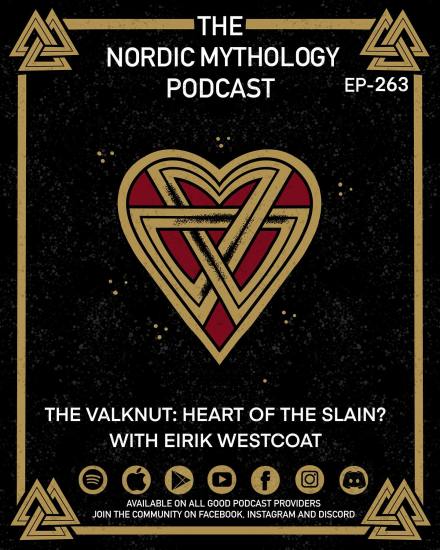
On April 28, I returned to the Nordic Mythology Podcast for the first time in two years. On this occasion, I talked about my article that identifies the Valknut as the Heart of the Slain. 😊

It runs for about 83 minutes. Now, the recording is available as episode #263 on all podcast platforms for everyone to enjoy. Ones that I have links for in this post are:

Apple Podcasts
Youtube

Note, of course, that with the Youtube version, you also get the video! It’s also available on Google Podcasts, Spotify, and various other major podcast directories. Enjoy!

Eagle’s Mead Audio Release!

My first major poetry book, Viking Poetry for Heathen Rites, was released with an audio collection alongside it, in which I recited many of the best poems from the book. Now, after many years of being in print, I’ve released a similar audio collection for Eagle’s Mead, with 27 tracks and running over an hour in length. And it’s available to preview and purchase on Bandcamp.

It’s an important milestone, because this is the only electronic release associated with it. The Eagle’s Mead book has only ever been released in a single hardcover edition—no paperback, kindle, pdf, or epub whatsoever. (Contrasting VPfHR, which is in both hardcover and paperback, and has been released in epub, kindle, and pdf—and with that audio collection.)

Check it out. If you’ve never read my Eagle’s Mead, this’ll be your first opportunity to experience many of the poems from that book. Like in the book itself, you’ll find a wide variety of poems about runes, magic, and esotericism. And it includes audio recordings of my modern poetic renderings of the ancient rune poems (OERP, OIRP, ONRP) and the Hávamál verses about Odin’s winning of the runes.

Enjoy!

My Runes/Poetry Course Starts Tomorrow!

If you’re the sort who likes waiting until the last minute, then now’s the time, because the last minute has arrived!

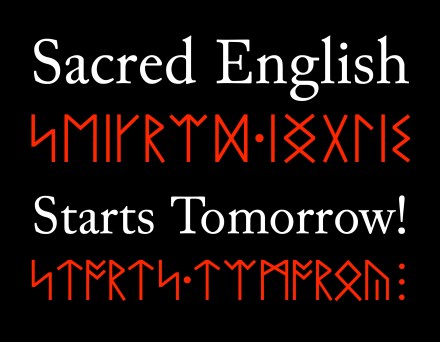
Tomorrow morning (that is, Wednesday at 800am), my online course in rune-writing and simple alliterative poetry starts. It’s called “Sacred English,” and with the combined powers of runes and poetry, you can make your English magical.

Join the American Futharch Revolution, and learn to write runes the way the ancient runemasters wrote them, and with the traditional poetic key.

In Hávamál 144, Odin challenges us to know how to write and read the runes. Are you ready to answer that challenge in the most authentic way possible in over a thousand years?

Not sure if you’ve got the time? After all, it is a cohort-course with a schedule to it. But as part of that, you’ll get plenty of my time—I’ll review the exercises, answer your questions, and prepare the four review lessons based on how the students are doing with the material. That could even include me creating additional teaching materials to address specific needs. It’s a unique opportunity to pick my brain on all this.

And everything will be pre-recorded, so you can fit it in your schedule however you like. Not to mention that you’ll also get to keep a large amount of videos, slides, audio, and guidebooks from the course.

For more details, see the page on my American Futharch website:
https://americanfutharch.com/sacred-english

or just jump straight to the course page and enroll at my new Skaldic Eagle Flight School:
https://skaldiceagle.thinkific.com/courses/sacred-english

Enjoy!
The Flow of Nine Worlds

This month’s poem is a look at the world tree and its worlds, from metaphysical perspective as to what the worlds are, and what they might mean for us as human beings today.


The Flow of Nine Worlds

All was Yggdrasil to the ancient Norse,
a fathomless Tree that framed the worlds,
nine in number, into a united whole.
Ginnungagap, a great emptiness,
was there in the beginning and there alone.
Still it’d have stayed, but there started a flow,
the first of flows, which formed the worlds.
Ice upwelling from the outer North
met fire flaming from the farthest South,
and a hailstone was made in the heart of it all,
Continue reading

Eirik’s Hymn and Some Updates

Cædmon’s Hymn is a nine-line piece of Old English Christian poetry that uses kenning-like phrases for its deity, such as heavenly kingdom’s warder, glory father, eternal drighten, and mankind’s warder. My thanks go to Mary Ellen Rowe, who pointed out that if you transpose these Old English kenning-like phrases into Old Norse, they sound a lot like kennings for certain Old Norse gods. Upon hearing that, I realized I could make an extremely loose “translation” of Cædmon’s Hymn that heathenized it completely. However, it has ended up as piece that should be considered “inspired by” Cædmon’s Hymn rather than as a translation of it. Also, I’ve named the gods directly in most cases. Like the original, it is in nine lines of continuous verse — which is also just like the sequence of prayers from my last two posts. Here is the result of that experiment, which I suppose could be called “Eirik’s Hymn.” 🙂

Continue reading

Audio for Gunnlaðarljóð

Today brings my tenth audio recording to this blog. This time, it is Gunnlaðarljóð, which was posted as text last November. My recitation uses the original Norse pronunciations of the names instead of the anglicized versions.

Here is the downloadable file of me reciting the poem:
Eirik Westcoat – Gunnlaðarljóð

And here is the inline player:

Enjoy! Feel free to share the file. For details, see the Creative Commons link below.

This post is:
Copyright © 2014 Eirik Westcoat.
All rights reserved.

The linked audio file of Gunnlaðarljóð is:
Copyright © 2014 Eirik Westcoat.
Creative Commons Attribution-NoDerivatives License.

The Duel, Part 1

I present another poetic rendering of a prose tale from the lore. It is the story of the first (and probably last) giant to challenge Thor to a formal duel, and it has several things in common with the last Thor story I posted three months ago about his visit to Geirrod (part 1 and part 2). Just like that tale, Snorri presents in it prose with many details, and he also quotes from a difficult skaldic poem that mentions the story as well. (The skaldic poem is Haustlöng by Þjóðólfr of Hvinir.)

Rather than a difficult skaldic meter, I have written my retelling in 20 stanzas of my usual and more accessible fornyrðislag. The spellings have been anglicized throughout. It is well known that Odin has many different names in the lore; less well known is that Thor also has many names, although not as many as Odin, of course. The reader will see quite a few of those names in this poem. Like the previous Thor tale, I present the first half here today, and the second half will follow next Wednesday. The poem’s title is simply “The Duel.”

Continue reading