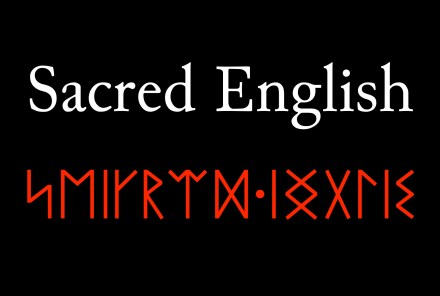
I’ve finally entered the world of independent online teaching with my first course on Runes and Poetry!
This course is my big epiphany in its most significant manifestation so far! Over three years ago, I had the lightning-strike idea that the rune names and futhark order for the Elder Futhark runes preceded the existence of rune-staves and runic writing. How could that be? Only one possible way: as tool to codify, teach, and promote the nascent system of early Germanic alliterative poetry, which certainly originated before the Proto-Germanics had writing. Having developed a poetry built on matching stressed sounds, it would be natural for the Proto-Germanics to name the sounds of their language in order to talk about them. (E.g., “This line alliterates on Hagalaz with a final stress on Tīwaz.”) The poetry itself would be the natural method for handing these names down the generations, in the form of the first “rune” poem. And when the early Germanics finally chose to adopt writing at some later time, these names for the sounds—and a canonical order for them in their “rune” poem—were already on hand to be applied to the rune-staves. (I’ve got an academic article eventually coming out that discusses this in more detail.)
I immediately recognized that all this was a great idea for modern alliterative poetry. Indeed, the sounds of modern English also had be named so that today’s alliterative poetry could become all that it could be, and the runes were equally an ideal vehicle for this. And so by reforming the Anglo-Saxon Futhorc, I created the American Futharch, the first full-fledged runic system in centuries, fully integrated with alliterative poetry, just as I envisioned it for the Elder Futhark and its oral precursor.
And now you can join me in my new course and learn runes integrated with the traditional poetic key. It’s called “Sacred English: American Runes and Alliterative Poetry,” and it’s a great way to turbo-charge your rune-writing knowledge of authentic rune writing with the American Futharch, while simultaneously learning to write simple alliterative poetry.
Instruction starts September 25, and last day to enroll this semester is September 27.
For more details, see the page on my American Futharch website:
https://americanfutharch.com/sacred-english
or just jump straight to the course page and enroll at my new Skaldic Eagle Flight School:
https://skaldiceagle.thinkific.com/courses/sacred-english
Enjoy!
 The Skaldic Eagle